Wortalleth West
Panic RoomWortalleth West first presents itself as a spectacular coastal residence: a broad, white-and-granite house set above Poldhu Cove, with a view that seems to promise openness and ease. That impression is steadily overturned. Behind a mirror in the master-bedroom closet lies a sealed steel door; elsewhere, concealed cameras watch the rooms, and the house’s power system supports a plan that could unleash Cascade. The house is at once a luxury property, a hiding place, and the mechanism of a threat whose scale exceeds its secluded setting.
Setting and Architecture
Wortalleth West stands north of Mullion, above Poldhu Cove, reached by a lane branching from the minor road to the cove before curving inland. Its approach establishes the contrast between an exposed landscape and a carefully composed estate. A white ranch-style wooden gate stands open at the entrance; the tarmac drive passes gorse and wind-shaped Monterey pines before dividing. One branch leads to a garage so large it could be a house, with balconied rooms above. The drive also passes a distant tennis court and curves around the broad rise on which the main house stands.
The house combines white wood, granite, and deeply eaved slate in a style that seems both Long Island and Cornish. Its half-hexagonal plan places one side directly toward the sea, while two angled sides form wings around a rear garden screened by shrubs. From the drive, a glint of reflected water suggests a swimming pool. Triple gables, wide windows, dormers shaped like dolphin backs, and a deep paved verandah complete an imposing but graceful exterior. Beyond its sloping front lawn, sea and sky appear to merge in clear weather; its design seems to belong to the view even as its scale and expense mark it as an exceptional private domain.
When Don Challenor first approaches, the blue sea is visible beyond the hedges and fields. He takes the turning too fast, correcting the car with a slight fishtail, and arrives at the open gate to find an estate whose scale confirms that its reported value is far beyond the expensive properties listed in the local newspaper. The house seems at first to justify its extravagance through beauty alone. That first impression matters: the apparent openness of the coastal setting stands in sharp contrast to the concealed systems and inaccessible spaces that Don will uncover inside.
Ownership and First Visits
Fran Revell arranges Don’s work at the house under a contract and gives him its keys. She identifies the client as Mona Jackson and explains that the live-in housekeeper left a couple of months earlier. Since then, a part-time assistant has been looking after the property, along with a part-time gardener. The keys carry a label printed with the initials FR/MH, a filing reference from Fran’s firm. The practical details of access and staffing establish Wortalleth West as a house that is both inhabited and, for the purposes of Don’s assignment, largely his to inspect.
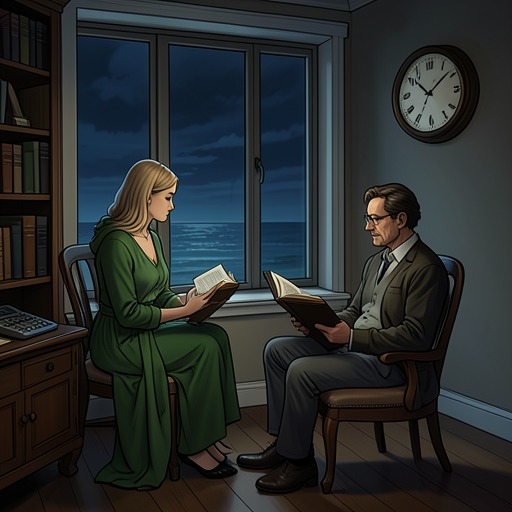
The house also draws people who are not simply fulfilling a professional obligation. When Fran follows Robin Pawley to Wortalleth West, she is struck by how perfectly its setting appears to suit it. She imagines the leisure its deep-blue sea and clean air might offer, but that vision remains a brief possibility rather than a life she takes up. Later, with time before another appointment, she returns on a whim, wanting a clearer impression of the property and suspecting she may not get another opportunity to wander through it. She finds no gardener outside, but a red Mercedes convertible is parked in front of the house and its driver is nowhere in sight. Uneasy at the unexplained car and hearing no movement within, she goes to the door and lets herself in.
The house’s outward calm is therefore never quite a guarantee of safety. Its quiet can mean simply that no one is visible; the apparently empty rooms may conceal activity, and the property’s access arrangements do not reveal who else has been there. That uncertainty becomes more pointed when Don and Jack Harkness return. They find the house locked but its alarm switched off, although Fran has the code and Don expects her to set it when leaving. Inside, the rooms appear normal and still, a convincing surface that the subsequent inspection begins to disturb.
The Hidden Steel Room
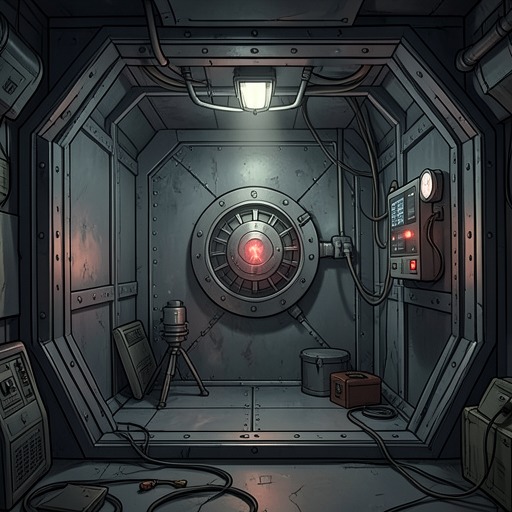
The concealed entrance is built into the master-bedroom dressing-room closet. When Don presses a point on the mirror’s frame, a click releases it: what looks like a mirror swings open as a door. Behind it is not an ordinary room but a thick steel surface. Don recognizes the arrangement as a likely panic room, a place where a householder could shelter from an intruder, with independent lighting and communications. The steel door should be open for someone entering, he reasons, but it is shut and locked from the inside. The house thus contains a refuge whose very security makes its sealed state a mystery.
On a later visit with Harkness, the mechanism still works: the mirror swings open and reveals the same solid steel door. But the closet’s rear wall has been damaged. In the adjoining bathroom, Harkness finds a jagged hole broken through the plaster, exposing steel beneath. Someone appears to have tried to smash through the reinforced wall with a sledgehammer and failed. The attack makes the concealed room more than an architectural curiosity: someone has sought access from the outside, while the door remains closed against entry from the closet.
The room’s opening mechanism is separate from the visible mirror-door. Harkness tells Don that an abstract painting by Peter Lanyon, Far West, hangs in the drawing room; behind it is a safe, and inside the safe is a switch that opens the panic-room door. When Amos French demands that Don open the room, Don lifts the painting from its hook and finds a grey steel safe about two feet square, with a countersunk handle and a dial numbered from zero to one hundred. The artwork that had offered Harkness and Don an image of flight over the Cornish coast becomes a cover for the control that can expose the house’s most dangerous secret.
Surveillance and Power
Wortalleth West’s concealed systems make its privacy deceptive. In the dark room behind the mirror, offline computers glow amber, digital clocks display the times in seven cities—London, Frankfurt, Moscow, Beijing, Tokyo, Los Angeles, and New York—and video screens show live images from cameras hidden in light fittings, cornices, and intrusion sensors. One screen records Don approaching the mirror-fronted closet; another shows him shortly afterward in the bedroom. Other cameras show Blake in the kitchen and Don on the landing, while still more screens display unoccupied rooms, a gym, and a wine cellar. The system makes the house a place of observation as well as concealment: ordinary movement through private rooms has been converted into images viewed elsewhere.
The building’s surfaces also hide an unusual source of electricity. Don notices that a section of wall feels smooth and plastic beneath his fingers: a clear layer lies over the white render. He identifies it as working like a solar panel. Jack Harkness bought the system from Mike Coleman’s company, along with a massive backup battery, and Coleman wanted to find out where that battery was kept. When Coleman came to look, Don says that Glenys Probert was the one who sent him away. The battery’s location remains unknown in these scenes, but the combination of solar generation and substantial backup power establishes that the house’s electrical demands are unusual.
That power system is tied to a much larger danger. The Wortalleth West system can initialize Cascade, a chain reaction in which nanobots trigger one another when they are within ultrasonic range. Harkness and his associate know of overrides at the house and in Locarno; without them, the process cannot be controlled once started. A breach of the panic room is the planned trigger. Whoever breaks into it may initiate Cascade without understanding what has happened, while those who arranged the system expect its effects to become apparent only later. The house is therefore not merely watched and fortified: its security architecture has been turned into the initiating condition for a threat beyond its grounds.
Signs of Violence and the House’s Role
When Don and Harkness search the house after returning to Cornwall, they find small disturbances within otherwise orderly rooms. In the kitchen, dark, deep scuff marks radiate across the tiles from a point near the telephone. Harkness draws attention to them, then to reinforced plastic trays and containers from the freezer. Packs of food lie thawed beside the sink, and the freezer is difficult to open because of the weight inside. Together with the damaged wall behind the closet, these traces make the house’s clean surfaces look less like evidence of harmless stillness than a cover over recent violence. The freezer is where Mike Coleman’s body has been concealed.
The house’s setting intensifies the contrast. It stands above a bright, open cove in a landscape whose apparent serenity invites visitors to imagine swimming, fresh air, and unhurried days. Yet inside, the cameras record people without their knowledge, the panic room remains sealed, and signs of an attempted breach and concealed murder accumulate among immaculate work surfaces. The property’s beauty does not dispel its menace; it gives secrecy a polished and plausible exterior.
Wortalleth West’s importance finally lies in the way its separate features converge. The mirror conceals the steel door; the painting hides the safe; the house’s power system supports the Cascade mechanism; and the surveillance network turns domestic space into monitored territory. What begins as Don’s real-estate assignment becomes an investigation into the house’s hidden structure and the people who control it. The estate’s apparent promise of refuge is inseparable from danger: its panic room was designed to shelter someone, but its breach is also meant to set a disaster in motion.